
If your morning cup has stopped working the way it used to - or if the side effects have started outweighing the benefits - here's everything you need to know about what else is out there.
Coffee is the most consumed psychoactive substance on Earth. That's not hyperbole - it's a straightforward demographic fact. Roughly two billion cups are consumed every day globally. The morning coffee ritual is so deeply embedded in modern culture that questioning it feels almost radical.
But a lot of people are questioning it. Not because coffee is inherently bad - it isn't - but because for a meaningful and growing segment of regular coffee drinkers, the relationship has quietly stopped working.
The afternoon crash that used to be manageable has become a significant productivity problem. The anxiety that caffeine amplifies has crossed from background noise into something that interferes with work and relationships. The sleep disruption that was always theoretical has become a nightly reality. Or sometimes the simplest version: the coffee just doesn't work anymore. Years of daily consumption have built enough tolerance that three cups produce what one cup used to produce, and the diminishing returns have made the whole ritual feel like maintenance rather than enhancement.
If any of that sounds familiar, this guide is for you. Not a guide to eliminating energy support from your life - most people genuinely need and benefit from some form of alertness and focus enhancement - but a guide to what else exists, how it works, and how to find the right alternative or combination of alternatives for your specific situation and goals.
Some of these options will be familiar. Some will be new. All of them have genuine evidence behind them, and all of them offer something meaningfully different from a cup of coffee - which is exactly what people looking for coffee alternatives actually need.
Why People Look for Coffee Alternatives: The Honest Picture
Understanding why people seek coffee alternatives helps clarify what the ideal alternative actually needs to do. "Natural alternative to coffee for energy" means different things to different people:
Anxiety and jitteriness: Coffee's caffeine content, particularly at the doses many regular drinkers have escalated to, consistently elevates anxiety in a large proportion of users. Caffeine triggers cortisol and adrenaline release that prepares the body for physical threat - which is not useful when the actual task is sitting at a desk writing or making calls.
The crash: Coffee's energy is borrowed time. By blocking adenosine receptors rather than generating energy, it delays the tired signal while the underlying tiredness accumulates. When the caffeine clears, you feel the combined weight of the adenosine you've been suppressing. For people whose jobs don't end at the same time as the caffeine, this creates a daily cycle of stimulation and crash that is genuinely disruptive to productivity and mood.
Sleep disruption: Caffeine's half-life is approximately five to six hours for most people. An afternoon coffee at 3pm still has significant caffeine levels at bedtime for many users - contributing to the paradox where tired people can't sleep well, making them more tired, making them need more coffee.
Digestive issues: Coffee is acidic and stimulates gastric acid production. For people with acid reflux, IBS, or sensitive digestive systems, it's a daily irritant that many would prefer to eliminate.
Tolerance and dependence: Regular coffee drinkers develop tolerance - the dose required to achieve the same effect increases over time, and skipping coffee produces withdrawal symptoms including headache, fatigue, irritability, and poor concentration. This isn't a character flaw; it's a predictable pharmacological outcome of regular adenosine receptor blockade.
Desire for something more: Some people aren't fleeing coffee's downsides so much as seeking something better - a morning energy ritual that produces not just alertness but genuine cognitive enhancement, mood support, and sustainable performance.
The best coffee alternatives address one or more of these specific motivations. Knowing which one applies to you helps you find the right fit faster.
Kratom: The Coffee Plant's Southeast Asian Cousin
This one surprises most people when they first encounter it - but it makes complete botanical sense.
Kratom (Mitragyna speciosa) is a member of the Rubiaceae family. The same plant family as coffee. In its native Southeast Asian habitats, kratom was used by agricultural workers in precisely the same role that coffee plays in Western cultures - a daily botanical tool for sustaining energy, managing physical demands, and maintaining positive mood through long workdays.
The parallel goes beyond botany. The traditional use of kratom is functionally analogous to coffee use: a plant from the coffee family, consumed regularly in leaf form, producing alertness and energy through botanical alkaloids. The difference is the specific alkaloids involved and their mechanisms.
Kratom's primary active compound, mitragynine, interacts with adrenergic receptors (producing energy and alertness), serotonin receptors (producing mood elevation and motivation), and at higher doses, opioid receptors (producing relaxation and physical comfort). At the lower doses used for energy applications - particularly with White Vein strains like White Maeng Da - the experience is primarily adrenergic and serotonergic: clean alertness, elevated motivation, directional energy that supports engagement with demanding tasks.*
What kratom energy feels like compared to coffee energy:
Coffee produces alertness that can feel agitated - the nervous system is activated broadly, producing the cognitive alertness alongside the cardiovascular elevation, the jitteriness, and the anxiety that many coffee drinkers find problematic. Kratom's energy at appropriate doses is more specifically directional - supporting alertness and motivation without the same degree of cardiovascular stimulation or anxiety production. Users consistently describe it as energy that wants to be used for something rather than energy that's just running in the background.*
No crash: This is the feature that surprises experienced coffee drinkers most. Kratom doesn't work by blocking adenosine accumulation - it doesn't delay your tiredness while allowing it to pile up. When the effects wear off, the transition is gradual rather than a cliff edge drop.*
Jubi's kratom energy products:
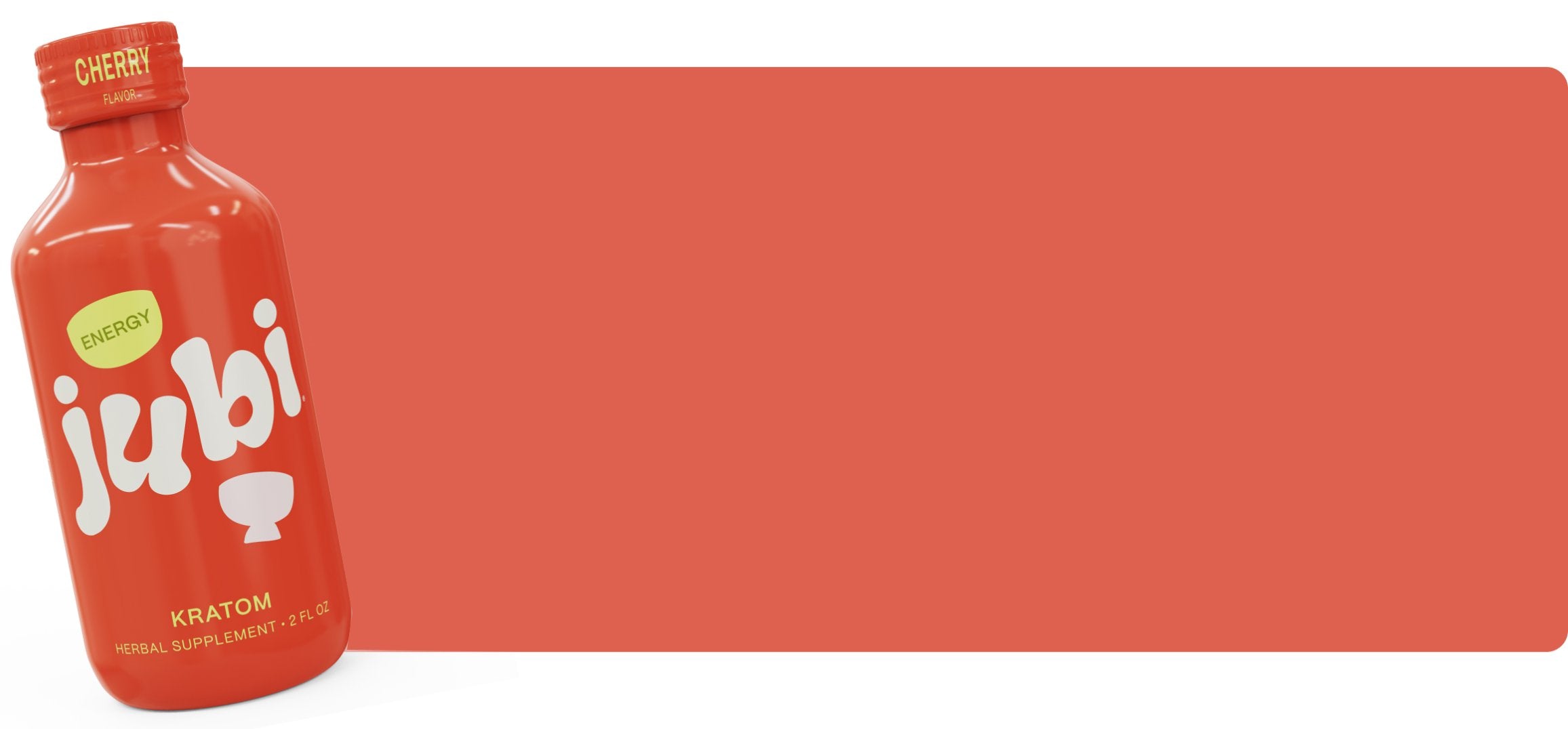
Cherry Energy Shot ($9.99): 50mg mitragynine per 2oz bottle - two 25mg servings of White Vein Kratom extract in a bold cherry flavor. Clean, plant-based energy without synthetic stimulants. The most popular entry point for people exploring kratom as a coffee alternative.
Lime Focus Shot ($14.99): 120mg mitragynine per bottle - two 60mg servings. Higher concentration for more pronounced cognitive focus and energy. White Vein Kratom, lime flavored, specifically designed for demanding cognitive performance.
Kratom Stick Packs ($9.99): 120mg mitragynine per stick in five flavors - Cherry Lime, Grape, Tropical Passion, Sour Apple, Peach Mango. Mix into water for a longer, more gradual energy drink experience. The most flexible format - adjust concentration by adding more or less water.
Important context: Kratom is not appropriate for everyone. It should be used responsibly, within recommended serving sizes, by adults who are not pregnant, nursing, or managing serious medical conditions without healthcare provider guidance. It may be habit-forming with heavy regular use. Verify legal status in your state before purchasing.
Lion's Mane Mushroom: Cognitive Energy From a Completely Different Direction
If coffee's energy is about forcing your tired brain to perform, Lion's Mane's energy is about optimizing your brain so performance comes more easily. These are fundamentally different approaches - and for many people, Lion's Mane addresses the actual problem more directly.
Lion's Mane (Hericium erinaceus) stimulates the production of Nerve Growth Factor (NGF) - a protein essential for neuron growth, maintenance, and survival. No other food or supplement achieves this through the same mechanism. The hericenones and erinacines in Lion's Mane cross the blood-brain barrier and upregulate NGF synthesis, supporting the neuroplasticity - the brain's capacity to form and maintain efficient neural connections - that underlies all cognitive performance.*
The energy Lion's Mane provides is cognitive energy - the mental stamina and clarity that determines how long and how well you can think under demand. It doesn't make you feel wired. It makes thinking feel easier, focus feel more natural, and mental fatigue come later and recover faster. The experience progressive Lion's Mane users describe after several weeks of consistent use is less "stimulated" and more "just working better."*
Why Lion's Mane complements rather than competes with other coffee alternatives:
Lion's Mane's benefits build over two to four weeks of daily use. The acute alertness that coffee provides - or that kratom or green tea provides - is a different, faster-acting mechanism. The ideal approach for most people is combining Lion's Mane's progressive cognitive enhancement with a faster-acting energy tool that covers the immediate alertness dimension.
This is exactly what Jubi's Lion's Mane Clarity + Energy Shot does:
Jubi Lion's Mane Clarity + Energy Shot ($5.99):
- 500mg dual-extracted Lion's Mane per serving
- 80mg natural caffeine from green coffee beans for immediate alertness
- 200mg L-Theanine for calm, sustained focus
- 250mg Cognizin Citicoline for attention and memory support
- 120mg standardized Ginkgo Biloba for cerebral circulation
- 150mg Bacopa Monnieri for learning and memory optimization
- B-vitamin complex for cellular energy metabolism
- Toasted coconut flavor, naturally sweetened with stevia
- No artificial colors, gluten-free, vegan-friendly
For people replacing coffee specifically because they want more than alertness - they want genuine cognitive enhancement - this is the most comprehensively formulated coffee alternative available in a convenient shot format.*
Matcha: The Original Calm Energy Drink
Matcha has been the beverage of choice for Zen Buddhist monks, Japanese scholars, and samurai for over a thousand years. The specific reason - not tradition, but pharmacology - is that matcha produces a qualitatively different alertness from coffee that was recognized as superior for focused, sustained practice long before anyone understood the biochemistry.
The key is the L-Theanine content. Matcha is made from shade-grown tea leaves - the shading process dramatically increases L-Theanine production as the plant compensates for reduced photosynthesis. Shade-grown matcha can contain three to five times more L-Theanine than conventionally grown green tea.
L-Theanine promotes alpha brain wave activity - the frequency associated with calm, focused alertness that is the optimal state for meditation, deep work, and creative thinking. Combined with matcha's caffeine content (roughly 70mg per serving, lower than most coffee preparations), the result is the calm alertness that centuries of tea culture have built traditions around and that modern research has confirmed in controlled trials.*
Matcha vs. coffee: the practical difference:
Coffee drinkers who switch to matcha consistently report the same core experiences: reduced anxiety, more sustained alertness without a pronounced crash, better ability to focus on complex tasks, and improved sleep quality when matcha replaces afternoon coffee. The caffeine content is real and provides genuine alertness, but the L-Theanine fundamentally changes how that caffeine feels in the body.*
Practical preparation notes:
Quality matters enormously with matcha. Ceremonial-grade matcha from reputable Japanese suppliers (particularly from Uji or Nishio growing regions) produces a genuinely different experience from culinary-grade powder. Preparation temperature matters - 175°F rather than boiling prevents bitterness and preserves delicate compounds. Proper whisking technique produces a smooth, frothy texture that improves both taste and compound distribution.
Matcha latte recipe for coffee replacement:
Whisk 1-2 teaspoons of ceremonial-grade matcha powder with 2oz of 175°F water until smooth and frothy. Add 8oz of steamed oat milk or plant-based milk of choice. Sweeten lightly with honey if desired. The resulting beverage is rich, satisfying, and produces the calm focused alertness that makes it one of the most effective coffee replacements available.
Green Tea: The Accessible Daily Alternative
For people who find the matcha preparation too demanding for daily life, high-quality loose-leaf green tea offers many of the same benefits in a more accessible format.
The caffeine-L-Theanine combination is present in all green teas, though in lower concentrations than shade-grown matcha. The resulting experience is gentler than both matcha and coffee - appropriate for people whose primary coffee complaint is too much stimulation rather than insufficient stimulation.
The green tea energy window:
Green tea's lower caffeine content (20-50mg per cup depending on variety and preparation) produces a milder, longer-lasting alertness curve than coffee. The L-Theanine modifies even this modest caffeine into a calm alertness rather than jittery stimulation. Many people find they can drink green tea later in the afternoon without the sleep disruption that coffee in the same window would produce.*
Varieties worth knowing:
Gyokuro - the highest-grade Japanese green tea, shade-grown like matcha leaves, producing the highest L-Theanine content among loose-leaf teas. Significantly more expensive than standard green tea but produces a markedly superior energy experience.
Sencha - the most widely consumed Japanese green tea, fresh and grassy in flavor, with good L-Theanine content and reliable daily-use energy support.
Dragonwell (Longjing) - a premium Chinese green tea with a distinctive chestnut-like flavor and good cognitive-supporting properties. The historical tea of Chinese scholars.
Yerba Mate: The South American Energy Tradition
Yerba mate (Ilex paraguariensis) occupies a fascinating position in the global energy beverage landscape - widely consumed throughout South America with the cultural significance that coffee holds in North America and Europe, yet largely overlooked in Western wellness conversations until relatively recently.
Mate contains caffeine (roughly 80mg per serving - comparable to a moderate coffee), theobromine (the gentler stimulant found in chocolate that produces a longer, smoother energy curve), and theophylline (a methylxanthine that also appears in tea and has mild bronchodilatory effects). This combination of three different methylxanthines produces an energy profile that many users find more pleasant and more sustained than caffeine alone.*
Beyond the stimulant alkaloids, yerba mate contains a remarkable concentration of antioxidants - reportedly higher than green tea in some measurements - alongside vitamins, minerals, and amino acids that contribute to a nourishing quality that coffee doesn't share.
The mate energy experience:
Experienced mate drinkers and coffee refugees who've switched consistently describe mate energy as cleaner and more sustained than coffee. The cardiovascular stimulation is less pronounced. The anxiety is absent or minimal. The crash is gentler. And the duration - four to six hours of sustained alertness - is longer than most coffee preparations.*
Traditional preparation:
Yerba mate is traditionally prepared in a hollowed gourd (also called a mate) with a metal filtering straw (bombilla). Hot water at around 160-170°F (not boiling) is poured over the dried mate leaves and sipped through the filtered straw. The same leaves can be re-steeped multiple times with progressively gentler caffeine content - a natural tapering effect that contributes to the absence of a sharp crash.
For people without traditional equipment, mate is also available in tea bags and in ready-to-drink canned formats that provide convenient access to its benefits without the preparation complexity.
Rhodiola Rosea: The Adaptogen for Mental Fatigue
Rhodiola rosea is an adaptogenic herb - a botanical that helps the body adapt to and resist physical, chemical, and biological stressors - that has been used in Siberian, Scandinavian, and Chinese traditional medicine for centuries as a tool for sustaining mental and physical performance under harsh conditions.
The mechanism relevant to energy is specific and interesting: Rhodiola appears to reduce the accumulation of mental fatigue by supporting the efficiency of mental work rather than stimulating the nervous system into higher activation. It influences monoamine neurotransmitter activity (dopamine, serotonin, and norepinephrine) in ways that support both alertness and mood without the cardiovascular stimulation of caffeine.*
Research context:
Rhodiola is among the better-researched adaptogens for cognitive performance. A notable controlled trial found that Rhodiola extract significantly reduced mental fatigue in physicians working night shifts - a population with particularly demanding cognitive requirements and poor recovery conditions. Several other trials have found improvements in cognitive test performance, reduced burnout symptoms, and improved mood under stress conditions.*
Where Rhodiola fits in a coffee alternative strategy:
Rhodiola is particularly appropriate for the specific coffee use case of getting through mentally demanding periods without the sharpness that the work requires degrading too quickly. It's not an acute stimulant - it doesn't produce the immediate alertness spike that coffee or kratom provides. It's more a fatigue-resistance tool that extends the window of effective cognitive performance before mental fatigue sets in.*
Rhodiola pairs naturally with other coffee alternatives: combine it with green tea or matcha for the L-Theanine/caffeine acute alertness, and let Rhodiola contribute the mental fatigue resistance that extends that alertness into a more productive cognitive work session.
Ashwagandha: The Indirect Energy Enhancer
Ashwagandha (Withania somnifera) doesn't provide energy in the conventional stimulant sense - it doesn't activate the nervous system, doesn't block adenosine, doesn't contain caffeine. What it does is remove one of the most significant barriers to sustained energy: chronic stress and elevated cortisol.
Chronic stress keeps the body in a state of physiological hyperactivation that consumes enormous amounts of energy without producing anything useful. The adrenal system that produces cortisol and adrenaline in response to stress is not designed for continuous activation - it's designed for acute threats. When modern life keeps it chronically activated, the result is a progressive depletion of energy reserves that no amount of coffee can fully compensate for.
Ashwagandha's adaptogenic effects - specifically, its ability to reduce cortisol levels and normalize the stress response - address this depletion at the source. Multiple randomized controlled trials have found meaningful reductions in perceived stress, cortisol levels, and fatigue in participants taking ashwagandha extract.*
In practice:
People who add ashwagandha to their routine often describe improved energy not as a stimulant effect but as a baseline elevation - feeling less depleted, more resilient, and more capable of accessing their existing energy reserves rather than running on stress-driven cortisol. This is a genuinely different kind of energy support than coffee provides, and for people whose fatigue is primarily stress-driven, it addresses the actual problem more directly.*
Ashwagandha works best taken consistently - effects build over two to four weeks of daily use, similar to Lion's Mane and Bacopa. It pairs naturally with acute-acting energy alternatives: ashwagandha in the morning for stress resilience, with kratom, green tea, or matcha for immediate alertness.
Ginseng: The Classic Energy Tonic
Ginseng - both Panax ginseng (Asian ginseng) and Panax quinquefolius (American ginseng) - has been used as an energy tonic in traditional Chinese medicine for thousands of years and has been extensively studied in modern research contexts.
The active compounds in ginseng (ginsenosides) support energy through several mechanisms: modulating hypothalamic-pituitary-adrenal axis activity (similar to ashwagandha, supporting stress resilience), influencing nitric oxide production (supporting circulation and oxygen delivery), and interacting with neurotransmitter systems in ways that support alertness and cognitive function.*
Research has found ginseng effective for reducing fatigue, improving cognitive performance under stress, and supporting physical endurance - making it one of the more versatile natural energy herbs available.*
Asian vs. American ginseng:
Asian (Panax) ginseng is more stimulating - appropriate for people who specifically need more energy and alertness. American ginseng is more calming and balancing - better for people whose energy problem is more about stress and depletion than insufficient stimulation. Understanding which profile you need helps you choose the right variety.
Ginseng tea is the traditional consumption format - simmering dried ginseng root in water for twenty to thirty minutes produces a mildly bitter, earthy tea with real energy-supporting properties. Standardized extract capsules offer more consistent dosing for supplemental use.
B-Vitamins: The Foundation That Everything Else Depends On
No guide to natural energy can be complete without addressing the nutritional foundation - because botanical energizers are working against a compromised baseline if cellular energy metabolism is impaired by B-vitamin insufficiency.
B-vitamins serve as coenzymes in the metabolic pathways that convert food into ATP - the cellular energy currency. Without adequate B1, B2, B3, B5, B6, B7, B9, and B12, the mitochondria that power every cell in your body cannot function at full capacity. The fatigue, brain fog, and low motivation that characterize B-vitamin insufficiency are genuinely indistinguishable from general low energy - and treating them with more coffee is treating a symptom while the underlying cause continues.
People most likely to be insufficient in B-vitamins: regular alcohol drinkers, people over fifty whose B12 absorption declines with age, vegetarians and vegans who may not get adequate B12 from diet, people taking metformin or proton pump inhibitors, and people under significant chronic stress whose B-vitamin requirements increase.
Jubi's Lion's Mane Clarity + Energy Shot includes a B-vitamin complex specifically because the cognitive ingredients in the formula work optimally only when the cellular energy infrastructure is properly supported. This is the kind of formulation thinking that distinguishes products built for actual performance from products built for marketing appeal.
Coconut Water: The Electrolyte Energy Optimizer
Dehydration is one of the most commonly overlooked contributors to fatigue and poor cognitive performance - and one of the easiest to address. Even mild dehydration (1-2% of body weight) produces measurable impairments in attention, working memory, and physical performance.
Coconut water provides hydration alongside electrolytes - potassium, magnesium, sodium, and calcium - that support cellular function in ways that plain water doesn't. The natural sugars provide a small glycemic contribution to energy without the sharp spike and drop of conventional energy drinks or sweetened coffee beverages.
Coconut water isn't a coffee replacement in terms of alertness production - it doesn't contain caffeine or any botanical alertness compound. But it's an important complement to any coffee alternative strategy because addressing dehydration removes a significant performance barrier that alertness-boosting herbs and botanicals can't compensate for.
Practical incorporation: A large glass of coconut water first thing in the morning - before any coffee alternative - addresses the overnight dehydration that contributes to morning grogginess. Many people find that proper morning hydration reduces their caffeine requirement significantly.
Building Your Coffee Alternative Strategy: A Practical Framework
The right coffee alternative isn't necessarily a single product - it's a strategy that covers the different things coffee was doing for you. Most regular coffee drinkers use coffee for several distinct purposes across the day:
What coffee typically provides:
- Morning wake-up and mood improvement
- Sustained cognitive alertness for work
- Midday energy maintenance
- Social ritual and sensory pleasure
- Habit and routine anchor
The best coffee alternative strategy maps different tools to these different functions:
Morning wake-up and mood: Jubi Lion's Mane Clarity + Energy Shot or Jubi Cherry Energy Shot - plant-based energy with mood support, no jitteriness, no crash. Or matcha prepared as a morning ritual with the same deliberateness as a coffee ceremony.
Sustained cognitive performance: Jubi Lime Focus Shot before demanding work sessions. Or green tea throughout the morning, with Rhodiola for mental fatigue resistance during extended sessions.
Midday energy maintenance: Kratom Stick Pack in preferred flavor mixed into water - adjustable concentration, sustained effects, five flavors that make it genuinely enjoyable.
Social ritual and sensory pleasure: Matcha latte or ceremonial-grade matcha whisked traditionally - the preparation ritual is as satisfying as coffee's and the beverage itself is genuinely delicious.
Habit and routine anchor: The Jubi Cherry Energy Shot's crack-and-drink format mirrors coffee's ease. The Lion's Mane Shot as a daily wellness practice creates a new positive habit that replaces the coffee habit structurally.
How to Transition Away From Coffee Without Misery
If you've decided to reduce or eliminate coffee, the transition matters almost as much as the destination. Abrupt caffeine cessation after years of daily use produces withdrawal symptoms - headache, fatigue, irritability, poor concentration - that typically peak at 24-48 hours and resolve within a week.
The tapering approach:
Reduce your coffee intake by roughly 25% every four to five days while introducing your chosen alternative in parallel. This allows your adenosine receptor sensitivity to gradually restore while you develop familiarity with how the alternatives work for you - which is important information to have before you've eliminated coffee entirely.
Hydration during transition:
Increase water intake significantly during the transition period. Caffeine withdrawal headaches are partly dehydration headaches - the vasoconstriction that caffeine produces ends during withdrawal, causing temporary vasodilation that changes cerebral blood pressure. Good hydration reduces the severity of this effect.
Give alternatives genuine trials:
Some coffee alternatives - particularly Lion's Mane, Bacopa, and ashwagandha - produce benefits that build over weeks rather than days. If you try one of these for three days and decide it doesn't work, you haven't given it a fair trial. Commit to a minimum two-week consistent use before evaluating cumulative adaptogens.
Don't expect identical experiences:
The most important mindset shift in transitioning from coffee is releasing the expectation that the alternative will feel exactly like coffee. It won't - and that's the point. Matcha feels calmer than coffee. Kratom feels more directional. Lion's Mane feels cleaner. These differences are features of the alternative, not failures to replicate coffee. Appreciate them on their own terms.
Frequently Asked Questions
Which coffee alternative has the most similar energy to coffee? Kratom at appropriate doses produces the closest functional analog to coffee's energy and mood effects - clean alertness, elevated motivation, and sustained focus without jitteriness. The Jubi Cherry Energy Shot is the easiest starting point.
Can I combine multiple coffee alternatives? Yes - many work synergistically. Combining Lion's Mane (for cognitive infrastructure), green tea or matcha (for calm alertness), and Rhodiola (for mental fatigue resistance) is a well-rounded daily stack. Don't combine multiple caffeine sources without tracking total daily caffeine intake.
What about people sensitive to caffeine? Lion's Mane, Rhodiola, ashwagandha, and ginseng provide energy support without caffeine. Kava's stress-reducing effects can indirectly improve energy by reducing the cortisol drain of chronic stress. The Jubi Strawberry Chill Kava Shot is appropriate for caffeine-sensitive users seeking plant-based support.
How long until I stop missing coffee? Most people find the transition takes two to four weeks. The acute caffeine withdrawal resolves within a week. The adjustment to different energy profiles - particularly if switching to Lion's Mane which builds progressively - takes several weeks to fully appreciate. Most people who complete the transition report they don't miss coffee as much as they expected.
Is the Jubi Lion's Mane Shot a complete coffee replacement? For many people, yes - particularly those whose primary coffee use is cognitive rather than physical. The 80mg natural caffeine provides real alertness, the L-Theanine modifies it into calm focus, and the Lion's Mane and nootropic stack progressively enhance the cognitive baseline that caffeine is trying to compensate for. At $5.99 per shot, it's also economical compared to specialty coffee.
These statements have not been evaluated by the Food and Drug Administration. These products are not intended to diagnose, treat, cure, or prevent any disease. Not for sale to persons under the age of 18 or the legal age for kratom use in your state. Consult a healthcare provider before use if you are pregnant, nursing, have a serious medical condition, or take prescription medications. Some products may be habit forming or lead to addiction. For the full warning statement, visit DrinkJubi.com.
Jubi does not ship to: Alabama, Arkansas, Indiana, Rhode Island, Vermont, Wisconsin, Sarasota County (FL), Union County (MS), Denver (CO), or San Diego (CA). Please verify local regulations before purchasing.