
A grounded look at what's actually driving professional interest in kratom-based beverages - the pharmacology, the practical appeal, the real risks, and how Jubi's format fits into the picture.
Something has shifted in how professionals talk about energy. A few years ago, the conversation was almost entirely about coffee optimization - timing, dose, cycling. Now a different category is entering the professional wellness conversation more frequently: kratom-based beverages, positioned not as a recreational product but as a functional tool for the specific demands of knowledge work.
Understanding why requires looking at both sides honestly - what kratom-based energy drinks actually offer that conventional stimulants don't, and what the genuine risks and open questions are that any informed professional should understand before trying them.
The Problem Kratom-Based Energy Drinks Are Being Used to Solve
The appeal starts with a real and well-documented frustration. Americans face unprecedented demands on their energy and attention, yet conventional stimulants come with tradeoffs: jitters, crashes, dependency, and disrupted sleep. That frustration is particularly acute for professionals whose work requires not just alertness but sustained, directed cognitive performance across hours - the kind that conventional caffeine can undermine as much as support when cortisol compounding and afternoon crashes enter the picture.
Most kratom users will tell you that the energetic effects are not at all like those of coffee or energy drinks: no jitters, no crash, no nervousness. Kratom is considered a nootropic because of its positive cognitive effects - many kratom users take it for motivation, mental clarity, and focus, without the negative effects of prescription medication or caffeine.
That description - motivation and mental clarity without the physiological noise of synthetic stimulants - maps directly onto what knowledge workers describe wanting when they talk about focus rather than raw energy. It's also why the professional interest in this category is coming from a different place than recreational use: it's being framed as a performance tool, not a mood-altering substance.
What the Pharmacology Actually Says
Kratom contains more than 40 active compounds, but the most significant for its energy effects are mitragynine and 7-hydroxymitragynine. These alkaloids interact with the body's opioid and adrenergic receptors, impacting neurotransmitters like dopamine and serotonin.
The dose-response relationship is the piece most often missing from casual descriptions of kratom - and it's clinically important. Kratom's effects shift dramatically based on dose: at 1-2g, the primary effect is stimulation and alertness; at 2-3g, balanced energy and focus; at 3-4g, energy with mild relaxation; at 4-5g, primarily relaxation; at 5g+, sedation. The practical implication is direct: for kratom energy and focus benefits, less is more - higher doses shift effects toward relaxation and sedation, the opposite of what productivity seekers want.
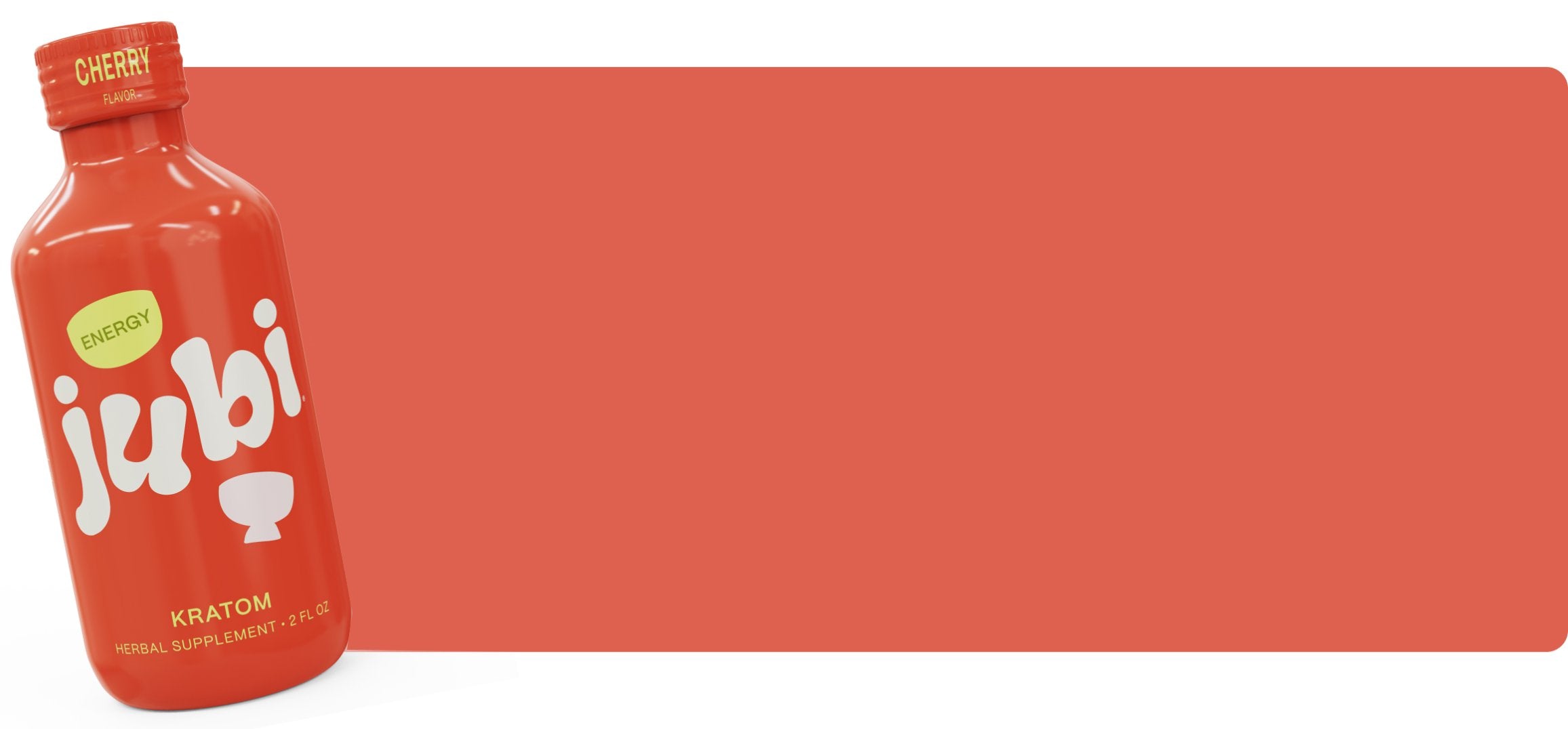
This dose-sensitivity is precisely why the ready-to-drink format Jubi uses is a meaningful advantage for professional use. Fixed, standardized doses - 50mg mitragynine in the Cherry Energy Shot, 60-120mg in the Lime Focus Shot, 120mg in the Kratom Stick Packs - remove the guesswork that comes with powder dosing and make it easier to stay in the energy-and-focus range rather than accidentally crossing into the sedation range. For more on how mitragynine's mechanism differs from caffeine, see What Is 80% Mitragynine Extract?
Why White Vein Specifically, and Why Maeng Da
Not all kratom has the same effect profile, and the professional use case maps specifically onto one part of the category. White vein kratom and certain green vein varieties tend to have alkaloid profiles that many users associate with increased alertness and mental clarity - these strains are typically harvested from younger leaves, which contain different alkaloid ratios than their more mature red vein counterparts.
Among white vein varieties, Maeng Da has the strongest consensus reputation for energy and focus specifically. White Maeng Da is widely cited as the go-to choice for energy and focus - Maeng Da strains are specifically cultivated for their high alkaloid content, and the white vein variety delivers a clean, focused experience. Green Maeng Da offers a more balanced alternative: the energetic effects come through quickly and, despite the surge of motivation, the vibe is not at all scattered - it helps you stay focused on the task at hand, and that focus stays put for hours on end.
Jubi's energy and focus products - the Cherry Energy Shot, Lime Focus Shot, and Kratom Stick Packs - use White Vein and White Vein Maeng Da specifically because of this alignment between strain profile and cognitive use case.
The Format Shift: Why Shots and Stick Packs Over Powder
The shift from powder and capsule kratom to ready-to-drink shots and stick packs isn't cosmetic - it reflects a genuine change in who is using the category and what they need from it. In the United States, kratom has shifted from traditional preparations to a rapidly expanding commercial market of powders, tablets, gummies, and concentrated energy shots - and within that shift, the beverage format addresses the two barriers that have historically limited professional adoption: inconsistent dosing and poor palatability.
The cold-water extraction process Jubi uses addresses both simultaneously. It produces a standardized mitragynine concentration per serving while removing the bitterness that makes raw kratom powder difficult to consume without significant masking - which typically means sugar loads that undercut the clean-energy proposition. The result is a product a professional can use in a work context the same way they'd reach for a coffee or an energy drink: without preparation, without palatability negotiation, at a known dose. More on how this fits into a demanding workday routine is in Jubi for Busy Professionals: A Smarter Beverage Choice and Drinks That Help You Stay Sharp During Long Work Hours.
The Risks: What an Informed Professional Needs to Know
A professional audience deserves a straightforward accounting of what the risk picture actually looks like - not a minimized version.
The CDC and MMWR published data in 2026 that every new kratom user should read: a CDC report documented a significant increase in kratom-related poison center cases from 2015 to 2025, largely tied to high-potency formulations - specifically products enriched with isolated 7-hydroxymitragynine, a μ-opioid receptor agonist that is distinct from traditional kratom leaf preparations and has prompted FDA calls for regulatory action focused specifically on these concentrated products.
This distinction matters practically: the FDA has taken steps to restrict 7-OH opioid products as a distinct category, precisely because of the meaningfully different risk profile they carry compared to traditional mitragynine-based kratom. When evaluating any kratom product for professional use, the relevant question is whether it uses standard mitragynine extract (the traditional energy and focus profile) or 7-OH concentration (the higher-potency, higher-risk category currently under regulatory scrutiny).
The Mayo Clinic's position on kratom is also worth reading directly before trying it: the amount of the active part in kratom leaves can vary greatly, making it hard to know the effects of a given dose, and kratom carries its own risk of addiction - some people take kratom to relax or to be more social, most likely thinking that kratom is natural and safe because it comes from a plant, but taking kratom can be harmful. Standardized, third-party tested products from transparent manufacturers reduce but do not eliminate this variability concern.
The practical safety guidelines that follow from all of this: use products with published third-party lab results confirming mitragynine content; stay within recommended doses and in the lower-dose energy range rather than escalating; don't combine with alcohol, opioids, sedatives, or other CNS-active substances; and consult a healthcare provider if you're on prescription medications. Full context is on the Jubi FAQ page.
What the Professional Use Case Looks Like in Practice
For professionals specifically, the most useful framing is product-to-moment matching rather than daily supplementation:
The Cherry Energy Shot (50mg mitragynine) is the lowest-risk entry point for someone new to kratom-based energy - accessible, lower dose, predictable. A useful first step before forming a view on whether the category is right for you at all.
The Lime Focus Shot (60-120mg mitragynine) is positioned as a strategic tool for peak-demand sessions - presentations, complex analysis, extended deadlines - rather than daily use. The motivational quality at this dose is what users in cognitively demanding roles describe most specifically as different from caffeine.
The Kratom Stick Packs (120mg mitragynine, sipped slowly) map onto the early-afternoon circadian dip window - sustained energy across a gradual curve rather than a single spike, with a hydration benefit that addresses a common compounding factor in afternoon energy drops.
For context on how these fit alongside Jubi's non-kratom cognitive support products, see How Jubi Supports Energy, Focus, and Wellness and Energy, Focus, or Relaxation: Finding Your Perfect Match.
Frequently Asked Questions
Is kratom legal for professional use? Kratom is legal in most US states, but is banned in Alabama, Arkansas, Indiana, Rhode Island, Vermont, and Wisconsin, with additional local restrictions in some counties and cities. Always verify local regulations before purchasing.
Is kratom safe to use regularly at work? At standardized low-to-moderate doses from lab-tested, transparent sources, the energy and focus use case has a long traditional-use history. That said, risk of dependence and individual variability are real and should be taken seriously - this is not a zero-risk product, and consulting a healthcare provider before regular use is advisable, particularly for anyone on prescription medications.
What makes the 7-OH products different and riskier? 7-hydroxymitragynine is a more potent μ-opioid receptor agonist than mitragynine and is the compound behind both the higher potency and the higher adverse-event profile documented in CDC data. Standard mitragynine-based products operate via different, lower-risk mechanisms at energy-range doses.
How is kratom in a ready-to-drink format different from powder? Standardized dosing per serving eliminates the guesswork that makes powder dosing inconsistent. Cold-water extraction removes bitterness without requiring sugar masking. Both factors specifically address the barriers that have historically limited professional adoption.
Should I tell my doctor I'm using kratom? Yes - particularly if you're on any prescription medications. Drug interaction risk is real, especially with CNS-active medications, and a healthcare provider is the right source for guidance on whether kratom is appropriate for your specific health profile.
These statements have not been evaluated by the Food and Drug Administration. These products are not intended to diagnose, treat, cure, or prevent any disease. Not for sale to persons under the age of 18 or the legal age for kratom use in your state. Consult a healthcare provider before use if you are pregnant, nursing, have a serious medical condition, or take prescription medications. Do not combine kava or kratom with alcohol. Some products may be habit forming or lead to addiction. For the full warning statement, visit DrinkJubi.com.
Jubi does not ship to: Alabama, Arkansas, Indiana, Rhode Island, Vermont, Wisconsin, Sarasota County (FL), Union County (MS), Denver (CO), or San Diego (CA). Please verify local regulations before purchasing.